
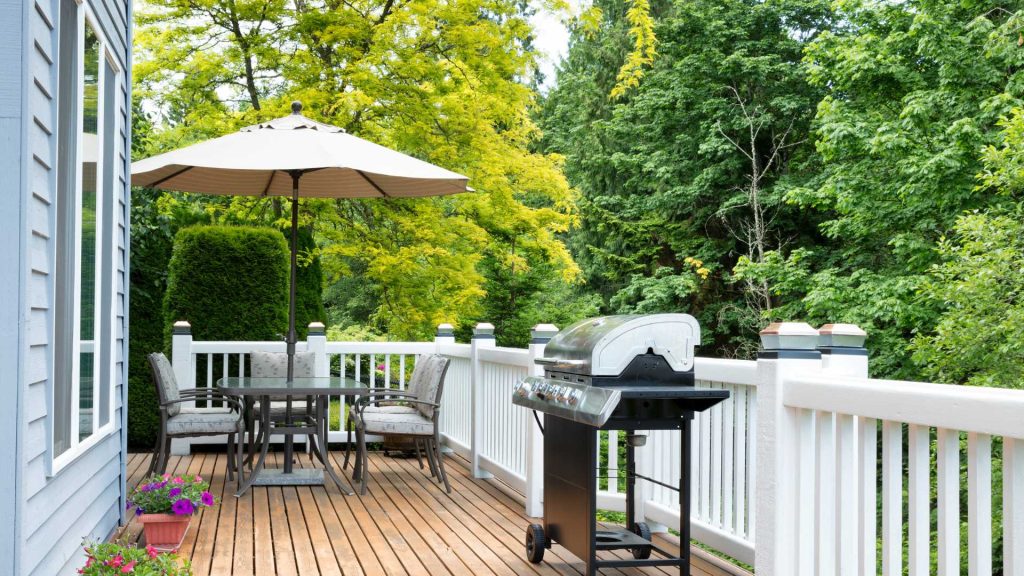
A small backyard is a design problem, not a dealbreaker. The moves that make a compact deck feel bigger are consistent: build in the seating, use a single level change to define space, keep the material palette calm, and design around how you’ll actually use it rather than trying to fit everything. Done well, a small deck beats a large one built by default. Here are the ideas that earn their space.
Build the seating in
On a small deck, freestanding furniture eats the floor. Built-in bench seating around one or two edges gives you places to sit without the visual clutter and wasted space of chairs, and the area underneath can hide storage for cushions or garden tools. The result feels open because the middle stays clear, and open is what makes a small space feel generous. It’s the single highest-impact move on a compact deck.
Use one level change, not three
On a small footprint, a single, deliberate step down or up does a surprising amount: it separates a dining spot from a lounging spot without walls, adds visual interest, and makes one modest surface read as two purposeful zones. The mistake is overdoing it; three levels on a small deck feels busy and eats usable space with transitions. One good level change is design; several is clutter. On a sloped small lot, that level change often solves the grade at the same time, which is where a stepped design earns its keep.
Keep the palette calm
Small spaces feel bigger when they’re visually quiet. A restrained material and color palette, one decking tone, one railing style, minimal contrast, makes a compact deck feel considered and open rather than cramped and cut up. Busy patterns, multiple materials, and heavy contrasting borders all shrink a small deck visually. Simplicity reads as calm, and calm reads as bigger.
Design around one main use
The biggest small-deck mistake is trying to fit everything: dining for eight, a lounge area, a grill station, and a fire feature onto a deck that comfortably holds one of them. Pick the thing you’ll actually do most, dinners for the family, morning coffee, a spot to entertain a few friends, and design the deck around that beautifully. A small deck that does one thing well is far more useful than one that does four things badly. This is exactly the sort of honest prioritizing good design is for.
Extend the deck’s reach without extending the deck
A few tricks make a small deck feel larger than its footprint. Continuing the decking line visually into the yard with a path or stepping stones borrows the surrounding space. Building right up to a fence or wall and using it as a backdrop makes the deck feel like a room rather than an island. And integrating a planter or two at the edges softens the boundary between deck and garden so the eye doesn’t stop abruptly at the railing. None of these add deck; all of them add the feeling of space.
Don’t forget vertical
When floor space is the constraint, the answer is to stop thinking about the floor. Anything that adds function overhead, an overhead element for shade, greenery at railing height instead of in floor planters, lighting mounted up on posts and rails, buys the deck presence and usefulness without spending the one thing a small deck can’t spare: square feet. On a small deck, every decision should be judged by whether it costs floor space, and vertical moves cost none.
When a small deck should become a multi-level one
Sometimes the honest answer to a small, sloped yard isn’t a small flat deck at all, it’s a compact multi-level deck that uses the grade to create two small zones stacked down the slope. On the right lot, that turns a cramped single level into a deck with genuine variety, without needing more square footage of yard. It’s not the answer for every small backyard, but on a slope it’s often the best one, and it’s worth asking about before defaulting to a single platform.
Frequently asked questions
Is a deck worth it for a really small yard?
Often more worth it than for a big one, because in a small yard the deck becomes the main usable outdoor space rather than one feature among many. Designed well, it transforms how the whole backyard works.
What’s the biggest mistake on a small deck?
Trying to fit too much. Cramming dining, lounging, and cooking onto a deck sized for one of them leaves all three cramped. Choosing one main use and designing around it beautifully is the fix.
Can built-in seating really save that much space?
Yes, noticeably. It removes the floor space chairs need to be pulled out and moved around, keeps the center clear, and often adds hidden storage. On a compact deck it’s the highest-value single choice.
Does a small deck need a permit?
Possibly not, if it’s genuinely small, low, and freestanding, but confirm against your city’s rules, and remember an exempt deck still has to be built to code. The size that makes it exempt is also the size where the ideas here matter most.
Ready to make the most of your space?
Schedule a deck estimate or call 737-363-4018. Send a photo of the yard, small or awkward as it is, and we’ll show you what it could become.